What Tech Companies Should Look For in a Conference Production Partner
If you are a CMO, VP of Marketing, or Head of Events at a tech company about to issue an RFP for your flagship conference, the decision you are about to make is more consequential than most procurement processes treat it. The wrong production partner does not produce a slightly worse event. They produce a brand-defining failure in front of your customers, your investors, your analysts, your developers, your press, and the second audience who will see it all on demand for the rest of the year.
That asymmetry of outcomes deserves a framework. This article is the one used by senior tech-company event teams evaluating conference production partners for user conferences, developer summits, sales kickoffs, and customer events at scale.
It is built around six criteria – the capabilities that separate strategic production partners from commodity vendors – with the questions to ask, the evidence to require, and the red flags to spot before the RFP issues. For the next step after partner selection – issuing the actual RFP – the event production partner guide and the forthcoming event RFP framework walk through the structure of the document itself.
Why Choosing the Wrong Production Partner Hits Differently for Tech Companies
The flagship tech conference is not a standard corporate event. It is livestreamed to a global audience. It is covered by industry press. It is attended by customers, investors, analysts, partners, prospects, and a developer or user community that judges your company by what they see on stage. The keynote is the moment your category positioning lands or does not. The product demo is the moment your roadmap is real or is not. The mainstage is the moment your brand becomes a story other people retell – or stops being one.
A production partner mismatch at this scale damages brand equity in front of every audience you have invested every other marketing line item in reaching. The cost of replacing a failing partner mid-program is two to three times the original engagement, with the additional cost of recovering the damage done before the replacement was made.
This is why the partner evaluation deserves more rigor than the typical event vendor RFP. The six-criteria framework below is the standard. The questions and evidence in each section are what separate strategic partners from polished decks.
The Six-Criteria Framework for Evaluating Conference Production Partners
After producing flagship conferences for technology, finance, and enterprise companies, six capabilities consistently separate strategic production partners from commodity vendors. The framework is built to be used inside a real evaluation – included in your RFP scoring matrix, embedded in your discovery conversations, and applied to every reference call you make. The six criteria, in priority order, are below.
Technical Production at Scale
Scale for a tech-company flagship is not 200 attendees in a hotel ballroom. Scale is 1,000-to-10,000-plus attendees, multi-screen general sessions, redundant video systems for live broadcast, complex rigging structures, and parallel programming across multiple rooms. Production at this scale is operationally and technically different from corporate event production – the equipment is different, the crew is different, the failure modes are different, and the recovery options are different.
The question to ask is direct: has this partner produced at your specific scale, on a multi-day program with broadcast, and what were the three most recent flagship-scale conferences they produced? Ask for the names, the venues, the attendee counts, and the broadcast scope. Confirm with references. A partner who cannot name three comparable productions in the last twenty-four months is not at your scale yet, regardless of how their pitch reads.
Multi-Day Logistics and Crew Management
Multi-day flagship conferences are exponentially more complex than single-day events. A three-to-five-day program means crew change-overs between general sessions, breakouts, and networking. It means hospitality logistics that run twenty-four hours a day. It means F&B integration with show flow. It means a sponsor expo floor that operates as its own production track alongside the main program.
Evaluate how the partner manages these. Specifically: does the partner have a dedicated logistics lead, separate from the production director? Does the production director absorb logistics or own production? What is the partner’s track record on load-in and load-out windows at flagship scale? Multi-day operational maturity is what surfaces here – and it is the layer most commonly missing from partners who present well in a one-day pitch.
Keynote and Mainstage Craft
For tech companies, the keynote is the event. The product launch keynote, the developer kickoff, the founder narrative, the executive presentation – these are the moments that get clipped, shared, replayed, and remembered. The production quality of these moments determines whether the conference is the brand-defining moment it was designed to be or the moment the brand wishes it had not produced.
Evaluate the partner against the question: has this partner produced product-launch-style keynotes at flagship scale? Do they have an in-house show caller, or do they outsource? Can they demonstrate camera direction quality, speaker confidence-monitor setup, teleprompter integration, and the rehearsal discipline that produces a keynote that does not look read?
The reference test here is specific: ask for a recording of a recent mainstage moment they produced. Watch the camera cuts. Watch the rehearsal. Watch the speaker’s confidence on stage. The craft surfaces immediately.
Sponsor and Expo Activation Experience
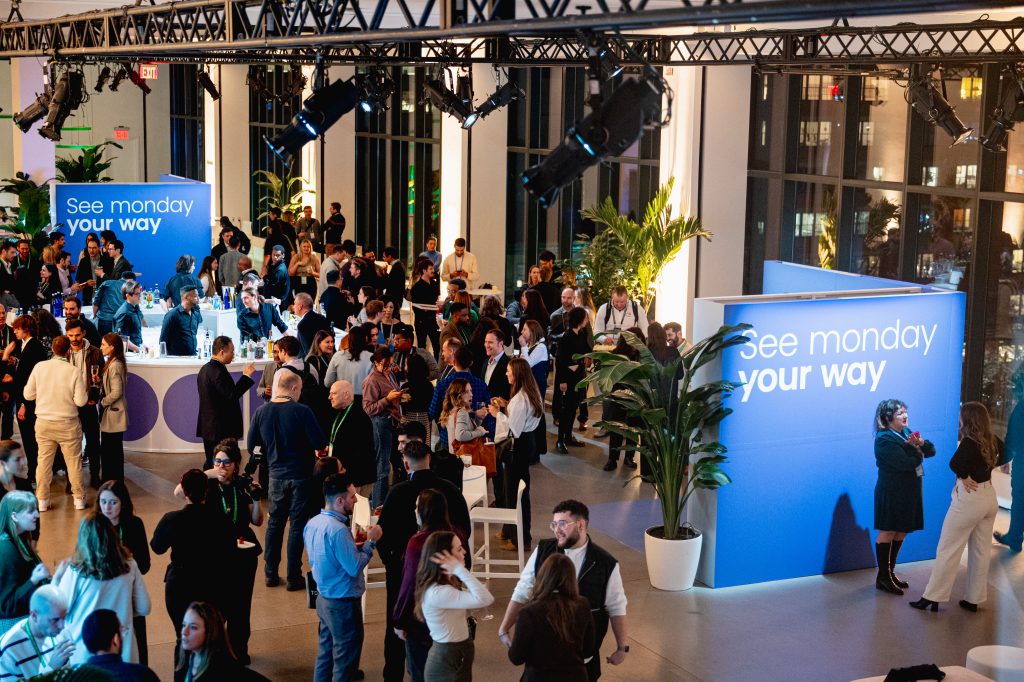
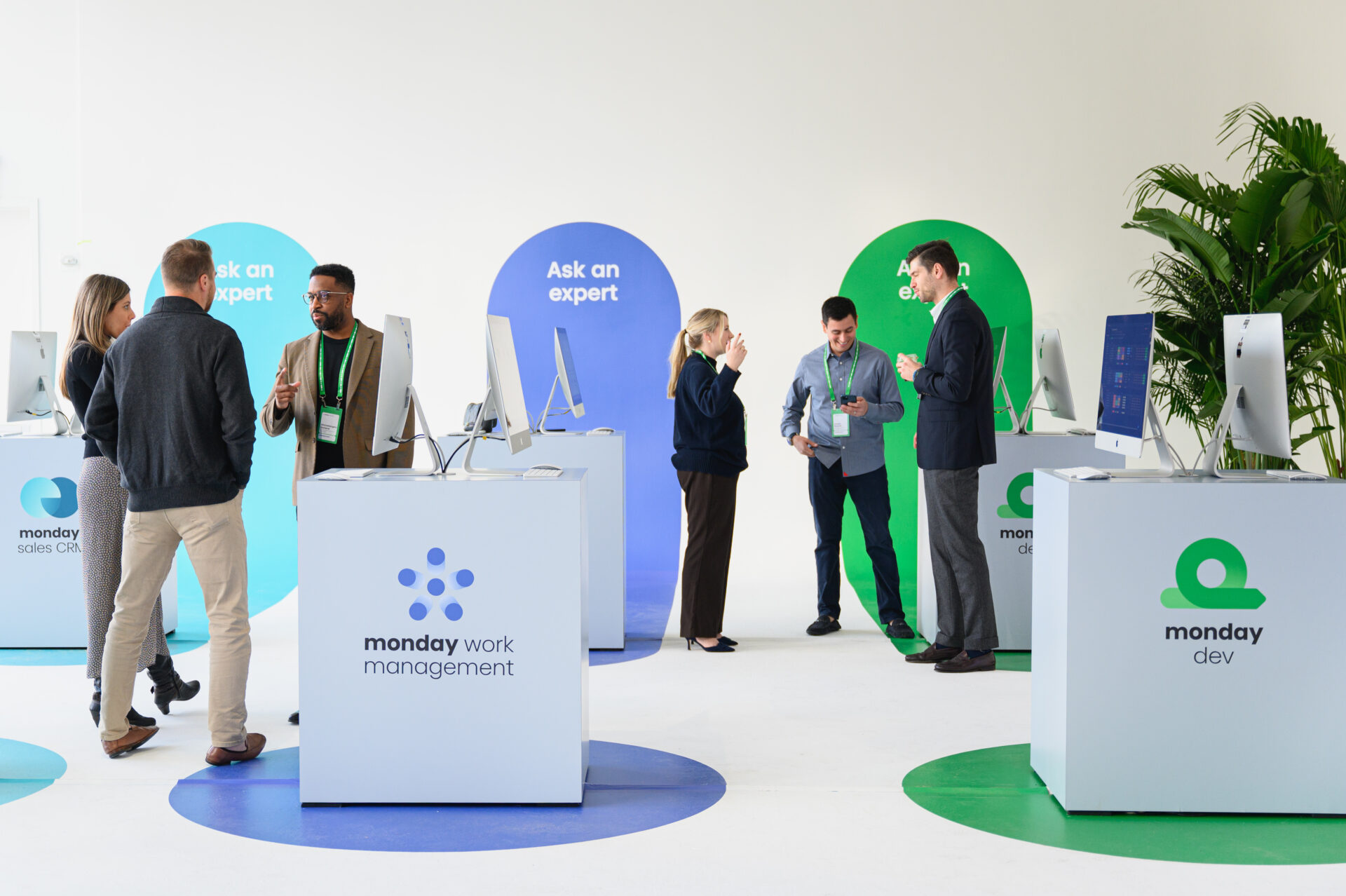
Sponsor revenue and expo floor management are major complexity drivers at large tech conferences. The expo is not a side area – it is its own production track that runs alongside the general session program with its own AV, its own crew, its own sponsor branding, its own attendee flow, and its own integration requirements with the main program.
Evaluate the partner’s experience here directly. Does the partner have experience managing sponsor booths, expo builds, branded sponsor activations, and dedicated sponsor sub-events (dinners, satellite programs, customer summits running alongside the main event)? Do they understand the logistics of a multi-sponsor expo floor that operates without disrupting the attendee experience?
Sponsor activation is often where inexperienced partners expose gaps. Strong partners run the sponsor program as a second production. Weak partners treat it as a logistics afterthought.
For models where Eventique supports agency partners on this layer specifically, see agency production partnership.
Scalability Across a Growing Event Program
Tech-company event programs grow. The user conference at 500 becomes the user conference at 2,500 becomes the developer summit at 5,000. The production partner sourced for 500 may not be the production partner who can deliver at 5,000.
Evaluate the partner’s trajectory: can this partner scale with you from your current scale to your next scale? Do they have the crew depth, vendor relationships, and multi-city production capability to match your program’s trajectory over the next three years?
A partner who maxes out at your current scale is a short-term fix. Ask about their largest and most recent program expansions. Ask about programs they have run at twice your current scale. The answer determines whether the partnership has a future or just a present.
Senior Production Leadership On-Site
This is the most commonly overlooked criterion in production partner selection, and it is the single most predictive criterion of show-day execution quality. Many production companies send senior leadership to the pitch and junior crew to the event. The team you met at the proposal stage may not be the team on-site.
Evaluate this with one direct question: who specifically will be on-site as production lead for our event, what is their personal track record, and can I speak to references from comparable events they have led? Request the lead’s name and bio as part of the proposal response – not as part of the contracting conversation, where the answer often changes.
Senior production leadership on-site is the difference between show-week issues that resolve in thirty seconds and show-week issues that escalate to your CEO. It is the standard the buyer should demand. To see how Eventique structures senior leadership on-site as the engagement model, see Eventique services.

The Questions to Ask Before Choosing a Production Partner
The six-criteria framework above is the strategic layer. Below are the operational questions to embed in every pre-RFP conversation, RFP response form, and discovery call. They are designed to reveal operational maturity, expose the soft spots that polished pitch decks hide, and naturally favor partners who actually deliver at flagship scale.
- Who specifically will be the on-site production lead for our event? What is their direct track record? Can I speak to references?
- What is your contingency process for a day-of technical failure during the general session?
- Walk us through how you would staff a 3,000-person multi-day developer summit.
- Describe the rehearsal cadence you build for executive talent – both technical and dress.
- What is your crew depth at flagship scale, and how do you handle a senior crew member becoming unavailable in the final 72 hours?
- How do you scope sponsor and expo activations alongside the general session program?
- Can you provide a recording of a recent keynote you produced for a tech company at comparable scale?
- What is your standard production contingency budget envelope, and how do you handle change orders mid-program?
Use the answers as scoring inputs. Use the recordings as evidence. Use the references as verification.
Red Flags to Spot Before You Issue an RFP
The red flags below are pattern signals – observations that, taken individually, may be explainable but, taken together, indicate a partner mismatch with the production quality your event requires. Each red flag below should trigger a deeper question, not a disqualification – but a pattern of three or more is a strong signal to widen the partner search.
Vague portfolio. The partner’s case studies do not name specific events, venues, attendee counts, or production scope. Strong partners name names. Weak partners use phrases like “we produce events for global brands.”
Junior-only pitch team with promises of senior leadership later. The proposal team is junior, and the pitch includes the promise that “our senior team will be involved as the engagement scales.” They will not be. The team in the pitch is the team in the engagement.
Inability to explain multi-day crew logistics. When asked how a 3-day conference’s crew structure works (load-in shifts, general session crew, breakout crew, expo crew, overnight reset crew), the answer is high-level instead of specific. Multi-day logistics is a maturity test – and it is the maturity layer most commonly missing.
No tech-company-specific client references. The partner’s portfolio is heavy on associations, financial services, or general corporate clients, with no tech-company flagship references in the last twenty-four months. Tech conferences are their own production category. A partner without tech references is not a tech-conference partner.
Pricing that does not account for production complexity. The proposal pricing is too low or too uniform across scope categories – a signal that the partner has not actually scoped the work or is underbidding to win the engagement and renegotiate later. Real production scope has variance; uniform pricing usually does not.
Resistance to providing a dedicated on-site production lead. When the question “who specifically will be on-site” is asked, the answer is evasive, deferred, or aspirational. This is the most important criterion in the framework. A partner who will not name the on-site lead in the proposal will not have a named on-site lead on show day.

Ready to Evaluate Production Partners for Your Next Tech Conference?
Talk to Eventique’s Production Team to scope your specific event and see how we work at flagship scale. We work with the event teams behind multi-day flagship user conferences, developer summits, and sales kickoffs. Contact us to start the conversation.
Frequently Asked Questions
The six criteria are: technical production at scale (proven flagship-scale references in the last twenty-four months), multi-day logistics and crew management (a dedicated logistics lead, not absorbed by the production director), keynote and mainstage craft (in-house show calling, demonstrated rehearsal discipline), sponsor and expo activation experience (the expo treated as its own production track), scalability across a growing program (crew depth and capability to match your next-tier scale), and senior production leadership on-site (named lead, with personal track record, who is actually on-site on show day).
An event technology partner provides software – registration systems, attendee apps, virtual event platforms, audience engagement tools, and integration layers. An event production partner provides physical production – stage design, AV systems, scenic builds, broadcast layers, crew, rigging, lighting, run-of-show, and on-site execution. The two are complementary, not interchangeable. Tech-company flagship conferences typically require both, with the production partner owning the physical execution and the tech partner owning the digital layer.
For a flagship conference, three to five partners is the practical range for an RFP evaluation cycle. Fewer than three risks under-evaluating the market. More than five generates more proposal volume than most internal teams can evaluate rigorously, and many partners will decline to respond to an RFP with five-plus competitors. Three to five well-chosen partners – selected through pre-RFP reference calls and portfolio screening – produces the best evaluation quality.
A dedicated production partner makes sense for flagship conferences with a production budget envelope above approximately $250,000 for a single event, or for tech companies whose event program includes recurring flagship conferences (annual user conference, annual sales kickoff, annual developer summit). Below that scope, a venue AV team plus a strong internal events lead may be sufficient. Above that scope, the production complexity exceeds what any venue AV team or generalist event vendor can absorb, and the cost of partner mismatch begins to exceed the cost of partner engagement.
For more on Eventique’s model for tech-company conference production, see Eventique services, our work, or agency production collaboration for embedded engagement models. Contact us to start.